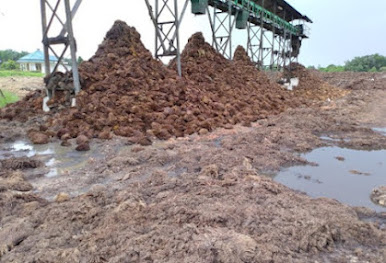
Fertilizer problems or soil fertility have always been the main topic or discussion for a large plantation business. This is very reasonable because maintaining productivity of crops can only be done by maintaining soil fertility or providing adequate fertilizer. For this reason, the budget for the supply of fertilizer is always a large portion of the plantation business. Then the condition leads to the question of how to make efficiency or save the fertilizer budget? Of course many techniques can be used for this purpose, but basically the selection or use of fertilizer that is appropriate and the effectiveness or absorption of fertilizer for plants is a key success factor in maintaining soil fertility. Let's try to answer the main question above.
When chemical fertilizers are increasingly abandoned because of their effects which damage the environment, there is no other choice but to use organic fertilizer. In large plantations such as oil palm plantations, basically there are also many biomass wastes from palm oil mills that can be used as fertilizer, such as fronds and palm oil trunks. But when these ingredients are also processed to become a particular product, and also the composting process of fibrous wood species takes a long time, the best choice is with organic manure. The question is where do you get livestock manure compost for the oil palm plantation? Actually there are more sources of organic fertilizer or compost that can be produced from palm oil mill effluent, namely from liquid waste. If the palm oil mill has an anaerobic digester, the biogas residue from the sludge can be used as organic fertilizer. At present there are not many palm oil mills that process liquid waste with the biogas unit, with the reason that the unit is considered expensive.
The history and experience of our predecessors before the use of chemical fertilizers can be used as a reference for this. At that time they were able to meet the fertilizer needs of their agricultural businesses, namely by sheep, goats, cattle and buffalo farming. The livestock manure is used for agricultural fertilizer and agricultural waste is used for animal feed. The basic pattern can also be developed for large plantations with several adjustment techniques to improve efficiency. Technical applications in the field that can be done, namely large plantations must cooperate with large farms or even ideally have a large farm to meet the needs of fertilizer for its plantations. For example, a palm oil plantation that has 10,000 hectares of plantation area, 100-200 (1-2%) hectares are used for sheep farming. The sheep breeding, not by just being caged, but grazing in the fields of pasture.

Why is sheep farming done in the pasture fields? This is because by grazing the cost of feed can be suppressed very large or the business becomes very economical. The biggest cost component of livestock business is feed. If the availability and supply of feed can be overcome then the other components become easier. The pasture is in the form of grass and shade trees. Making grass always available is the essence of the business, even it can be said that the pasture is grass farming itself. Rotational grazing is the best grazing technique at the moment. When the grass is fertilized with sheep dung during the grazing, the dirt produced when in the cage can be used for fertilizer on large plantations such as the oil palm. The biogas unit can be used to optimize the utilization of dirt from the cage.
Basically, sheep farming can also stand alone and also be profitable.
Therefore, sheep farming can be done separately. In the case when an
energy plantation is used for
the production of wood pellets,
it is still constrained by various things such as the presence and
supply of electricity, so the farm business can still be run properly.
The production of large-scale wood pellets
in various regions in Indonesia is currently still constrained due to
the electricity supply. This will certainly hamper the growth of the
wood pellet industry so there needs to be another way to overcome this,
which insha Allah will be discussed later.
With this concept, not only increases plantation and meat production,
but also a complete closed cycle business that is environmentally
friendly and sustainable. Honey bee farming can also be added for
optimization because obviously the bees besides helping the pollination
process will also produce honey, a superior product of high economic
value. Various food problems, insha Allah, can be overcome with this
concept. This is because from the production side it can be made very
efficient with the 2 biggest cost components being reduced significantly
by fertilizer and animal feed with the integration of large plantations
and large farms.
Although it has used compost from livestock manure, there are still more
techniques that can be applied to improve fertilizer efficiency by
using
biochar. With
biochar, the fertilizer will be retained in the biochar pores so that
slow release makes it effective for fertilization. In addition, biochar
will also hold the fertilizer from leaching due to high rainfall, so
that the use of fertilizer can also be saved significantly. Biochar will
also be the home of microbes to decompose organic matter into nutrients
needed for plants. So, in short, with biochar, the productivity of
plantations is high, but the use of fertilizer is minimal because it is
efficient, especially when fertilizer is produced from the farm itself.
This biochar can be produced by processing the plantation biomass wastes
by pyrolysis. For more details about pyrolysis can be read
here.