Tampilkan postingan dengan label biomass refinement. Tampilkan semua postingan

Jumat, 15 Juni 2012

Huge Demand of Torrified Biomass For Energy Application


Biomass ranks fourth as energy resource on global basis. Biomass is CO2 neutral and contains very little sulfur, hence it does not contribute greatly to acid-rain problems. Biomass have unique role on a renewable energy source.While the growing need for sustainable electric power can be met by other renewables, biomass is our only renewable source of carbon-based fuels and chemicals. Bioenergy is the word used for energy associated to biomass, and biofuel is the bioenergy carrier, transporting solar energy stored as chemical energy. Biofuels can be considered a renewable source of energy as long as they based on sustainable biomass production.

As Europe is very much the center of the global wood fuel market in general and the wood pellet/briquette market in particular, it comes as no surprise that vast majority of big wood fuel producers  of many countries have European countries as their final destination. With the goal set by the European Union to achieve a 20% share of renewable energy in the energy mix and a 20% decrease in greenhouse gas emissions by 2020 (DIRECTIVE 2009/28/EC, 2009) it is likely that the increase in EU demand for bioenergy will accelerate. However, it is also likely that a large share of future use of bioenergy in Europe will be from biomass of non-European origin as the resources are unlikely to be cost cost-competitive compared to biomass to biomass imported from other parts of the world.  

Trading wood fuel is always complex due to the biomass itself being both low in value per volume unit as well as difficult to store and transport as a result of it being a “living material” and hence susceptible to degradation from biological processes. Torrefaction is a technology to improve the quality of the biomass fuel and is followed by densification (pelleting / briquetting) will save transportation costs. Torrefaction has many advantages that overcome some problems in the wood fuel in general.

The quantities of biomass co-fired in large coal fired and other fossil fuel-fired power plant boiler have increased fairly dramatically over the past few years, particularly in Northern Europe but also elsewhere in the world. The level of co-firing activity worldwide, and the co-firing ratios at specific plants, are likely to increase further over the next few years.

Biomass materials have significant levels of inorganic matter as impurities, and many of the practical problems encountered with the combustion of biomass materials, or the co-combustion of biomass materials with coal and other fossil fuel, are associated with the nature and behaviour of the biomass ash and the other inorganic constituents. In practical terms, the ash-related problems in biomass combustors and boilers, and in plants co-firing biomass with more conventional fossil fuels, have commonly been associated with:
-The formation of fused or partly fused ash agglomerates and slag deposits at high temperature within furnaces;
-The formation of bonded ash deposits at lower gas temperatures on the heat exchange surfaces in the boiler convective sections and elsewhere;
-The accelerated metal wastage of boiler components due to gas-side corrosion and erosion;
-The formation and emmision of sub-micron aerosols and fumes; and
-The handling and utilization/disposal of ash residues from biomass combustion plants, and of the mixed ash residues from the co-firing of biomass in coal-fired boilers.

In very general terms, the nature of the problems and the impact on plant perfomance depend both on the characteristics of the biomass fuel, i.e. principally on the ash content and the ash chemistry, and on the design and operation of the combustion equipment and the boiler. Raw material have significant role of the densified (pellet/briquette) torrefied biomass quality. We will choose raw material with low ash content and a high ash melting temperature.

The peat and coal have the higher ash contents, but only a relatively small portion of the mineral material is in the water and acetate soluble fractions and is considered to contribute to the formation of the fine ash/aerosol material. In the case of the biomass materials, the total mineral contents are lower, but a much higher proportion of the mineral material is considered to contribute to the formation of the fine ash/aerosol fraction. The ash residue is normally weighed to provide an estimate of the ash content of the fuel, and then analysed for the ten major elements present in coal ashes, i.e. SiO2, Al2O3, Fe2O3, CaO, MgO, TiO, Na2O, K2O3, P2O5 dan SO3.

Usually slagging takes place with biomass fuels containing more than 4% ash and non-slagging fuels with ash content less than 4%. The ash content of different types of biomass is an indicator of slagging behaviour of the biomass. Generally, the greater the ash content, the greater the slagging behaviour. But this does not mean that biomass with lower ash content will not show any slagging behaviour. The temperature of combustion temperature, the mineral compostion of ash and their percentage combined determine the slagging behaviour. If conditions are favorable, the the degree of slagging will be greater. Minerals like SiO2, Na2O and K2O3 are more trouble some.

The selection of raw materials is an important factor for the production of torrified biomass. High quality torrified biomass need to be produced to meet a variety of industrial and domestic needs. Chemical treatment of raw materials can be made ​​to increasing the quality of raw materials, but it will do if the quality of raw materials is not sufficient anymore. Finally a reliable technology for the production of  torrified biomass absolutely necessary to meet those needs.

Jumat, 04 Mei 2012

Green Technology For Palm Oil Mills

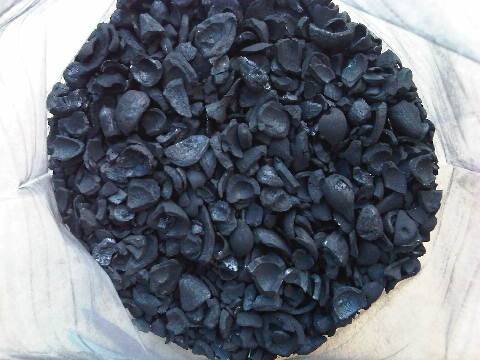
Pyrolysis  is the best technology for palm oil mill biomass waste utilization and on the other side to meet the energy needs of the production process at the oil mill.  Energy is one of the highest cost component  in palm oil mills. Reducing  the cost of production is certainly a very attractive  option to increase the profits of the industry. In addition to  reducing the palm oil mill biomass waste and energy  sufficiency, pyrolysis  application will also provide benefits to soil fertility for the  use of biochar plantations, as shown below. Charcoal from  palm empty fruit bunches  are more suitable for the biochar production to  increase soil fertility due to the high ash content which is about 16.60% or higher than ash of palm shell. Charcoal from empty fruit bunches also good for barbeque charcoal, it means lower quality than industrial charcoal application.

Production of  "green fuel"  of pyrolized palm shells are very potential and promising for palm shell  charcoal briquettes.  With our technology the palm shells can be pyrolyzed for increasing energy density  as high as possible, especially for metal casting or smelter applications with calorific value of 8,000 kcal / kg or more.  Biooil which is the liquid pyrolysis products can be directly used as fuel in the boiler furnace or further purified  for the production of a variety of liquid fuels or as raw material for various chemicals. While  the wood vinegar,liquid products other than biooil will be used as fertilizer  for the palm oil plantation.


Conventional Energy system  of palm oil mill looks  like the diagram below

Conventional Energy System in Palm Oil Mill

Will then be turned into such a scheme following for the  application of continuous  pyrolysis:
Improved Palm Oil Mill with Continous Pyrolysis System

Waste heat recovery from the pyrolysis unit was also  still be used to increase energy production.

Excess  of oil palm shell is also potential for torrefied wood production.Our pyrolysis technology is able to work on the torrefaction mode in addition to the pyrolysis itself. More on our continuous pyrolysis technology, please  click here or here.

Sabtu, 21 April 2012

Three Motivations For Biomass Thermal Conversion

At least, three motivating factors on biomass thermal conversion, like is mentioned below :

A.    Renewability Benefit
Fossil fuel like coal, oil and gas are good and convenient source of energy, and they meet the energy demands of society very effectively. However, there is one major problem: Fossil fuel resources are finite and not renewable.Biomass on the other hand, grows and is renewable. A crop cut this year will grow again next year; a tree cut today may grow up within a decade. Unlike fossil fuel, then, biomass is not likely to be depleted with consumption. For this reason, its use, especially for energy production, is rising fast.

We may argue against cutting trees for energy because they serve as a CO2 sink. This is true, but a tree stops absorbing CO2 after it dies. On the other hand, if left alone in the forest it can release CO2 in a forest fire or release more harmful CH4 when it decomposes in water. The use of a tree as fuel after its life provides carbon-neutral energy as well as avoids greenhouse gas release from deadwood. The best option is new planting following cutting, as is done by some pulp industries. Fast-growing plants like switch grass and Miscanthus are being considered as fuel for new energy projects. These plants have very short growing periods that can be counted in months.

B.    Enviromental Benefit
With growing evidence of global warming, the need to reduce human-made greenhouse gas emissions is being recognized. Emission of other air pollutants, such as NO2, SO2, and Hg, is no longer acceptable, as it was in the  past. In elementary schools and in corporate boardrooms, the environment is a major issue, and it has been major driver for biomass thermal conversion such as pyrolysis for energy production. Biomass has a special appeal in this regard, as it makes no net contribution to carbondioxide emission to the atmosphere.

Regulations for making biomass economically viable are in the place in many countries. For example, if biomass replace fossil fuel in a plant, that plant earns credit for CO2 reduction equivalent to what the fossil fuel was emitting. This credits can be sold on the market for additional revenue in countries where such trades are in practice.

Carbon Dioxide Emissions
When burned, biomass release the CO2 it absorbed from the atmosphere in the recent past, not millions of years ago, as with fossil fuel. The net addition of CO2 to the atmosphere through biomass combustion is thus considered to be zero.

Sulfur Removal
Most virgin or fresh biomass contains little to no sulfur. Biomass-derived feedstock such as municipal solid waste (MSW) or sewage sludge does contain sulfur, which requires limestone for capture of it. Interestingly, such derived feedstock also contains small amounts of calcium, which intrinsically aids sulfur capture.

Nitrogen Removal
A combustion system firing fossil fuel can oxidize the nitrogen in fuel and in air into NO, the acid rain precursor, or into N2O, a greenhouse gas. Both are difficult to remove. In a pyrolysis system, nitrogen appears as either N2 or NH3, which is removed relatively easily in the syngas-cleaning stage.
Nitrous oxide emission results from the oxidation of fuel nitrogen alone. Measurement in a biomass combustion system showed a very low level of N2O emission (Van Loo and Koppejan, 2008, p.295)

Dust and Other Hazardous Gases
 Highly toxic pollutants like dioxin and furan, which can be released in a combustion system, are not likely to form in an oxygen-absenced pyrolyzer. Particulate in the syngas is also reduced significantly by multiple gas clean up systems.

C.    Sociopolitical Benefit

The sociopolitical benefits of biomass are substantial. For one, biomass is locally grown resource. For one, biomass is a locally grown resource. For a biomass-based power plant to be economically viable, the biomass needs to come from within a certain distance from it.  This means that every biomass plant can prompt the development of associated industries for biomass growing, collecting, and transporting.
Some believe that a biomass fuel plant could create up to 20 times more employment than that created by a coal-or oil-based plant (Van Loo and Koppejan, 2008, p.1).  The biomass industry thus has a positive impact on the local economy.

Another very important aspect of biomass-based energy, fuel, or chemicals is that they reduce reliance on imported fossil fuels. The volatile global political landscape has shown that supply and price can change dramatically within a short time, with a sharp rise in the price of feedstock. Locally grown biomass is relatively free from such uncertainties.

Sabtu, 14 April 2012

New Uses of Charcoal Increasing in Japan

The consumption of carbon in Japan increased from 38,800 t (meric ton) in 1985 to 192,000 t in 1999. In 1999, 27% of the consumption, Or 50,835 t, was used for purposes other than fuel, as shown in Figure below. The highest proportion usage, i.e. 30.6%, was in the agricultural land, mainly as soil amendment. The second highest, i.e., 22.3%, was in the livestock industry, where charcoal powder was mixed with litter or animal feed for deodorization. Other uses were in the humidity control of houses, water purification other than by activated charcoal, as a reducing agent or a decolorant in industries, etc. Thus, the use of charcoal with various characteristics is currently diversified in Japan.
Marketing of the new uses of charcoal besides fuel in Japan in 1999. Source : association of the of the new uses of charcoal in Japan (2001)
 To meet the demand of course reliable pyrolysis system will be used for this. With plant capacity begin 60 ton/day up 200 ton/day INPUT and abundant biomass feedstock available especially in Indonesia and South East Asia region, we ready as your partner to make your dream come true.

Rabu, 11 April 2012

Entering the Second Generation Biofuel With Pyrolysis

The first generation biofuels are characterized by the production of biodiesel and bioethanol from food feedstock will soon be abandoned, it is because of fears of biofuel feedstock competition with human food needs. Conditions that encourage the birth of a second generation biofuels using biomass (non-food) as a raw material. Pyrolysis is a technology to produce second generation biofuels. The potential of biomass is abundant in Indonesia and on the other side of the energy needs that can not be fulfilled so that the pyrolysis of this application will be very promising.


Industrial-scale pyrolysis technology that can produce biofuels to meet the energy needs of Indonesia's current needs. Our pyrolysis technology has specific advantages that can work on torrefaction mode (mild pyrolysis) with torrefied wood products / torrefied biomass and the pyrolysis mode (slow pyrolysis) with the primary product BioCarbon (charcoal). Both products, wood & BioCarbon torrefied has many uses as a superior fuel and it takes a variety of industries for various applications. In both these processes will also be produced biooil and syngas, which can also be used for fuel or raw material of various chemical industries. To get a more detailed overview of this technology following our presentation or here.

Selasa, 10 April 2012

Physical Aspect On Biomass Pyrolysis

From a thermal standpoint, we may divide the pyrolysis process into four stages. Although divided by temperature, the boundaries between them are not sharp; there is always some overlap :

-Drying (~100 oC). During the initial phase of biomass heating at low temperature, the free moisture and some loosely bound water is released. The free moisture evaporates, and the heat then conducted into the biomass interior.
-Initial Stage (100-300 oC). In this stage, exothermic dehydration of the biomass take place with the release of water and low-molecular-weight like CO and CO2.
-Intermediate Stage (>200 oC). This is primary pyrolysis, and it takes place in the temperature range of 200 to 600 oC. Most of the vapor or precursor to bio-oil is produced at this stage. Large molecules of biomass particles decompose into char (primary char),  condensable gases (vapors and precursors of the liquid yield), and noncondensable gases.
-Final Stage (~300-900 oC). The final stage of pyrolysis involves secondary cracking of volatiles into char and noncondensable gases. If they reside in the biomass long enough, relatively large-molecular-weight condensable gases crack, yielding additional char (called secondary char) and gases. This stage typically occurs above 300 oC (Reed, 2002, P.III-6). The condensable gases, if removed quickly from reaction site, condense outside in the downstream reactor as tar or bio-oil. It is apparent from figure below that a higher pyrolysis temperature favor production of hydrogen, which increase quickly above 600 oC. An additional contribution of shift reaction further increase the hydrogen yield above 900 oC, in which typically used in gasification process since biomass pyrolysis use in lower temperature than gasification (range 400-600 oC).


Shift Reaction

Releses of Gases During Pyrolysis of Wood
Temperature has a major influence on the product of pyrolysis. The carbondioxide yield is high at lower temperature and decrease at higher temperature. The release of hydrocarbon gases peaks at around 450 oC and then starts decreasing above 500 C, boosting the generation of hydrogen.

Hot char particles can catalyze the primary cracking of the vapor released within biomass particle and the secondary cracking occurring outside the particle but inside the reactor. To avoid cracking of condensable gases and thereby increase the liquid yield, rapid removal of the condensable vapor is very important. The shorter the residence time of the condensable gas in the reactor, the less the secondary cracking and hence the higher the liquid yield. There’s always see the market demand of biomass pyrolysis products to meet that need. To see how our continous pyrolysis plant can do this, please click here and to find what real application on biomass pyrolysis for South East region please read the all articles in this blog.

Jumat, 06 April 2012

Effect of Heating Rate in Pyrolysis Process

The rate of heating of the biomass particle has an important influence on yield and composition of the product. Rapid heating to a moderate temperature (400-600 oC) yields higher volatiles and hence more liquid, while slower heating to that temperature produces more char. The operating parameters of a pyrolyzer are adjusted to meet the requirement of the final product of interest. Tentative design norms for heating in a pyrolyzer include the following :

-To maximize char production, use a slow heating rate (<0.01-2.0 oC/s), a low final temperature, and a long gas residence time.
-To maximize liquid yield, use a high heating rate, a moderate final temperature (450-600 oC), and a short gas resiedence time.
-To maximize gas production, use a slow heating rate, a high final temperature (700-900 oC), and a long gas residence time.

Production of charcoal through carbonization uses the first norm, more detail about our pyrolyzer please click here or if you want more considerations about charcoal production please click here.

Jumat, 30 Maret 2012

Which one is better, pelletization of torrefied biomass or torrefaction of pelletized wood?


Torrefaction, a process different from carbonization, is a mild pyrolysis process carried out in a temperature range of 230 to 300 °C in the absence of oxygen.  This thermal pretreatment of biomass improves its energy density, reduces its  oxygen-to-carbon (O/C) ratio, and reduces its hygroscopic nature. During this process the biomass dries and partially devolatilizes, decreasing its mass while largely preserving its energy content. The torrefaction process removes H2O and CO2 from the biomass. As a result, both the O/C and the H/C ratios of the biomass decrease. But Torrefaction will increases the relative carbon content of the biomass. The properties of a torrefied wood depends on torrefaction temperature, time, and on the type of wood feed. Torrefaction also modifies the structure of the biomass, making it more friable or brittle. This is caused by the depolymerization of hemicellulose. This makes it easier to co-fire biomass in a pulverized-coal fired boiler or gasify it in an entrained-flow reactor. There is a 29 to 33% increase in energy density (energy per unit mass) of the biomass through torrefaction. This increases its higher heating value (HHV) to about 20 MJ/kg.  To know more advantages of the torrefaction, please click here.
In biomass, hemicellulose is like the cement in reinforced concrete, and cellulose is like the steel rods. The strands of microfibrils (cellulose) are supported by the hemicellulose. Decomposition of hemicellulose during torrefaction is like the melting away of the cement from the reinforced concrete. Thus, the size reduction of biomass consumes less energy after torrefaction.
During torrefaction the weight loss of biomass comes primarily from the decomposition of its hemicellulose constituents. Hemicellulose decomposes mostly within the temperature range 150 to 280 °C, which is the temperature window of torrefaction. As we can see from  Figure below, the hemicellulose component undergoes the greatest amount of degradation within the 200 to 300 °C temperature window. Lignin, the binder component of biomass, starts softening above its glass-softening temperature (~130 °C), which helps densification (pelletization) of torrefied biomass. Unlike hemicellulose, cellulose shows limited devolatilzation and carbonization and that too does not start below 250 °C.

Weight loss in wood cellulose, hemicellulose, and lignin during torrefaction

Thus, hemicellulose decomposition is the primary mechanism of torrefaction. At lower temperatures (< 160 °C), as biomass dries it releases H2O and CO2. Water and carbon dioxide, which make no contribution to the energy in the product gas, constitute a dominant portion of the weight loss during  torrefaction. Above 180 °C, the reaction becomes exothermic, releasing gas  with small heating values. The initial stage (< 250 °C) involves hemicellulose depolymerization, leading to an altered and rearranged polysugar structures (Bergman et al., 2005a). At higher temperatures (250–300 °C) these form chars, CO, CO2, and H2O. The hygroscopic property of biomass is partly lost in torrefaction because of the destruction of OH groups through dehydration, which prevents the formation of hydrogen bonds.
A typical reaction time is about 30 minutes. The properties of torrefied wood depend on (1) the type of wood, (2) the reaction temperature, and (3) the reaction time. Pelletization may not increase the energy density on a mass basis, but it can increase the energy content of the fuel on a volume basis. Pelletization of torrefied biomass is better than torrefaction  of pelletized wood from the standpoint of process energy consumption and  product stability.This is because :
a. Torrefied biomass (torrefied wood), for example using sawdust as feedstock, so the torrefaction process will consume less energy due to the smaller particle size than the pelletized wood (wood pellets).  Surface material can be in contact with the process of torrefaction is also larger in general when the particle size is smaller, so that better product quality (product stability). Normally before entering the torrefaction process feedstock will be diminished to the size of a certain size and drying up to a certain moisture content.
b. Physical form of pelletized wood (wood pellets) will be damaged due to torrefaction so irregular and will tend to shrink. While torrefied biomass has no problem with it because the physical form of the final product after pelletization.