Tampilkan postingan dengan label soil fertility. Tampilkan semua postingan

Senin, 10 Maret 2025

Urgency of Biochar Production Industrial Capacity

The provision or application of biochar to agricultural land follows the 4Rs rule, namely the right source (appropriate biochar raw material), right place (appropriate application area), right rate (appropriate dosage) and right timing (appropriate time). The physical and chemical properties of biochar differ depending on the raw material and production process. By following the 4R rules, biochar performance can be maximized. The effect of biochar on plants will be clearly visible (significant) when the 4R rules are met. With a dose / rate reaching 20 tons / ha (depending on the influencing condition factors), the need for biochar is also large. This is why biochar products are rarely sold online, namely because of the large volume.

Unlike soil amendments such as compost, the effects of biochar can be felt for quite a long time or for several types of agricultural crops, namely not only in one planting season, but repeatedly. This also makes the provision or application of biochar not as frequent as compost. And in the end, of course, the economic aspect is a determining parameter whether biochar makes agricultural businesses more profitable or not. The price of biochar on the market is an important concern for users or farmers.

The lack of biochar production in Indonesia is currently a barrier to biochar application in large agricultural lands, even when farmers' awareness of biochar is also increasing. This is the driving force for the importance of adequate biochar production, especially industrial capacity. Only with adequate biochar production can biochar application in agricultural lands or degraded lands be carried out optimally. The urgency of industrial capacity biochar production is even greater, especially when the biochar production also gets carbon credit, of course this will be even more interesting. 

Minggu, 22 Desember 2024

Maximizing the Rate of CO2 Absorption from the Atmosphere Based on Biomass

Maximizing the rate of CO2 absorption from the atmosphere is very important considering the rate of addition of CO2 concentration to the atmosphere is not comparable to the rate of CO2 absorption. This is what makes the CO2 concentration continue to increase. To balance this speed, a strategy is needed to increase the rate of CO2 absorption. The use of biomass will be very effective and provide multiple benefits for human life. 

CO2 from the atmosphere needs to be captured through biomass production through the process of photosynthesis in plants. Fast-growing species of plants that have high photosynthesis rates are needed for this. Furthermore, biomass, especially wood from fast-growing species of plants, is used as raw material for biochar. Furthermore, biochar is used to improve soil fertility (soil amendment) in various types of agricultural and forestry plants.

Biochar production with slow pyrolysis will also produce excess heat, syngas and biooil that can be used as energy sources. The benefits of biochar production will be obtained from the sale of biochar, the sale of carbon credits and the use of slow pyrolysis by-products. With conditions like this, efforts to increase the speed of CO2 absorption from the atmosphere should be increased. How fast and how much CO2 volume can be absorbed will depend on the type of fast growing species used, the area of ​​planting and the capacity of biochar production.

Biochar For Patchouli Plantation

Indonesia is famous for producing various essential oils, including patchouli oil, clove leaf oil and so on. The main use of essential oils is mainly for food, pharmaceuticals, fragrances (perfumes). The potential of this country to develop essential oils is very large due to climate factors, land area and soil fertility. World export-import statistics data show that consumption of essential oils and their derivatives has increased by around 10% from year to year. Of the 70 types of essential oils traded on the international market, citronella oil, patchouli, vetiver, ylang-ylang, cloves, pepper, and jasmine oils are supplied from Indonesia. Indonesia is the largest country in Southeast Asia producing essential oils and is among the top 10 in the world.

Patchouli production centers in Indonesia are in Bengkulu, West Sumatra, and Nangro Aceh Darussalam. The quality of Indonesian patchouli oil is known to be the best and controls 80-90% of the world's market share or the largest supplier of patchouli oil in the world. This patchouli oil comes from the distillation of dried leaves to extract the oil which is widely used in various industrial activities. Patchouli oil is used as a fixative or binder for other fragrance ingredients in perfume and cosmetic compositions. The area of patchouli planting reaches 21,716 ha spread across 11 provinces in Indonesia, and in 2008 about 2,500 tons of patchouli oil were produced.

Patchouli plants commonly cultivated in Indonesia are Aceh patchouli because the oil content is > 2% and the oil quality is patchouli alcohol (PA) > 30% higher than Java patchouli which has an oil content of <2%. Furthermore, with Aceh patchouli, there are three varieties of patchouli plants found in Aceh, namely Tapaktuan patchouli, Lhokseumawe patchouli, Sidikalang patchouli. The PA levels of the three varieties vary, namely: Tapaktuan (28.69-35.90%), Lhokseumawe (29.11-34.46%), and Sidikalang (30.21-35.20%).

Patchouli Oil Production in Sentra Province 2015-2020**)

One of the factors that support plant growth and optimal production is the availability of sufficient nutrients in the soil. The level of nutrient availability for patchouli plants must be optimal to obtain high growth and oil content. Patchouli is known to be very greedy for nutrients, especially nitrogen (N), phosphorus (P) and potassium (K). Patchouli plants are among those that require quite a lot of nutrients, so that production continues to run optimally, fertilizer application is carried out very seriously. This is so that the level of soil fertility must be maintained optimally if we expect optimal patchouli agricultural production. Therefore, in the shifting patchouli cultivation system, there will be a very rapid decrease in land fertility which will damage the land.

Patchouli can be cultivated on dry land, thus the development of patchouli plants is very relevant to the potential of dry land which is quite extensive in Indonesia compared to rice fields. In fact, dry land is the most widely distributed sub-optimal land, which is around 122.1 million ha consisting of 108.8 million ha of acidic dry land and 13.3 million ha of dry climate dry land. The development of patchouli plants has a dual purpose, in addition to increasing farmers' income, it also increases the productivity of dry land which is widely spread in Indonesia.

To improve land quality, namely by applying biochar. The application of biochar to agricultural land functions as a soil amendment that can improve the chemical properties of the soil (pH, cation exchange capacity, total N, and available P), the physical properties of the soil (bulk density, porosity and the ability of the soil to hold water). Improvement in the quality of the chemical and physical properties of the soil has an impact on the availability of nutrients and water through the ability of biochar to retain nutrients and water. Ultimately, the addition of biochar has implications for increasing the productivity of patchouli plants. In the future, it is hoped that with the application of biochar, more suboptimal and degraded lands which can be restored and plants productivity increased.

Optimizing the use of dry land for food crop cultivation needs to begin with land rehabilitation efforts so that plants can produce optimally. Soil amendments that are cheap, readily available and can last a long time in the soil are expected to be able to trigger the rate of increase in dry land productivity. The potential for agricultural waste to be converted into soil amendments (biochar) in Indonesia is quite large. Biochar applications have been proven to improve the quality of physical and chemical properties of the soil, as well as increase water availability. Crop productivity also increases in line with the recovery of land quality.

Biochar can also be added during composting so that more nitrogen (N) content can be absorbed in the biochar. The higher the nitrogen (N), the better the compost quality will be. Total N is one of the macro elements needed by plants in large quantities, accounting for 1.5% of the dry weight of the plant. Nitrogen is useful in the formation of protein, a component of plant chlorophyll, and if morphologically N plays a role in the formation of leaves and stems of plants or the vegetative formation of plants. Phosphorus is an absolute nutrient needed by plants after nitrogen. Symptoms of phosphorus (P) nutrient deficiency are seen as the color of the plant becomes dark green or purplish green which is then followed by older leaves turning purplish. The addition of biochar and compost, in addition to increasing the productivity of patchouli leaves, can even increase the yield of patchouli oil from an average of 2% to 4% and the patchouli alcohol content of patchouli oil from an average of 32% to 40%.

Minggu, 27 Oktober 2024

Biochar from Wood Waste and Forestry Waste

The era of decarbonization and bioeconomy continues and continues to grow over time. While some people focus on the carbon neutral sector such as the production of biomass fuels such as wood pellets, wood briquettes or wood chips, people who focus on negative carbon seem to be fewer, including the use of CCS (Carbon Capture and Storage) and biochar production. Compared to CCS, biochar production with pyrolysis is easier and cheaper so it is projected to become a future trend. Logically, the negative carbon scenario is actually much better because in addition to reducing the concentration of CO2 in the atmosphere, while the neutral carbon scenario only does not increase CO2 emissions in the atmosphere, but does not reduce or absorb CO2 in the atmosphere. CO2 sequestration or biochar carbon removal (BCR) is currently also the most industrially relevant carbon removal technology. BCR is a key solution for real climate change mitigation today and its development is very rapid. BCR also has a vital role in the carbon removal technology portfolio. 


Woody biomass, especially from wood industrial waste and forestry waste, is a potential raw material for biochar production, even this type of wood biomass is the best raw material because it can produce high quality biochar, namely fixed carbon of more than 80%. The potential for wood biomass raw materials in Indonesia is very large, estimated at 29 million m3/year from forest harvesting waste, and 2 million m3/year from wood processing industry waste including 0.78 million m3 in the form of sawdust (the yield of the sawmill industry ranges from 50-60% and as much as 15-20% consists of sawdust). And that does not include if there is a biomass plantation or energy plantation dedicated to biochar production.

With the condition of agricultural land, plantations and forestry which are experiencing a lot of degradation, the need for biochar is also very large. Among the factors causing the decline in land fertility is the use of chemical fertilizers and pesticides for decades continuously and tends to be excessive. This causes a decline in soil quality which has an impact on crop production because it makes the land more acidic and hard which is estimated to reach millions of hectares. In addition, the price of chemical fertilizers is increasingly expensive and difficult to obtain, which results in low agricultural production, so the government is forced to import several agricultural commodities to meet the needs of the community. This actually does not need to happen considering the potential land in Indonesia is very large, it only needs to improve the condition of the land so that it can be optimal again. Making damaged land fertile is not difficult, it only takes perseverance to repair and care for the land so that it continues to be fertile.

Meanwhile, dry land consists of ultisol soil of 47.5 million ha and oxisol of 18 million ha. Indonesia has a coastline of 106,000 km with a potential land area of ​​1,060,000 ha, generally including marginal land. Millions of hectares of marginal land are spread across several islands, have good prospects for agricultural development but are currently not well managed. The land has a low fertility rate, so technological innovation is needed to improve and increase its productivity. Not to mention post-mining land which is almost all very damaged and also covers millions of hectares. And biochar is the right solution that can restore the condition of the land to be fertile again. 

Slow pyrolysis is the best technology for biochar production. But the technology used must be efficient and emissions meet the threshold standards of the country concerned. In addition, excess heat and/or liquid products and gas products from pyrolysis should also be utilized. With the criteria for pyrolysis technology as above, in addition to the quality and quantity of products, namely biochar, can be maximized, the production process also does not cause new problems in the form of environmental pollution. This is very much in line with biochar business activities so that it becomes a solution to the problem of industrial biomass waste from wood and forestry waste as well as a solution to climate problems. Even the utilization of by-products (excess heat and/or liquid products and gas products from pyrolysis) can also encourage the emergence of other environmentally friendly and renewable products.

In economic terms, the outline can be as follows, namely with an investment of 10 million US dollars, approximately 200,000 tons of biochar with more than 400,000 carbon credits will be produced over a period of 10 years. Or if with an investment of 100 million US dollars, almost 2 million tons of biochar and more than 4 million carbon credits will be produced over a period of 10 years. And for example, with a selling price of biochar of 100 dollars per ton and also a carbon credit of 100 dollars per unit (per ton of CO2), then within 10 years the investment has increased 6 times or it only takes about 1.7 years for the initial investment to return (payback period). Of course, when the price of biochar is higher and / or its carbon credits, of course the return on capital will be faster. And that does not include the utilization of liquid and gas products from pyrolysis and excess heat which also have economic potential that is no less interesting. The trend of the future business era will not only focus on financial profit but also provide solutions to environmental problems and climate problems, and of course solutions to social problems by creating jobs.    

Rabu, 08 Desember 2021

The Urgency of Ex-Coal Mine Reclamation With Biochar

The large number of ex-coal mines that are not reclaimed causes various environmental problems and even life safety. There have been many casualties from the former coal mine pit. The simple logic should be that after the coal deposit is taken or extracted during the mining activity, the land is returned and repaired so that the quality is better than before the mining activity or at least the same, but not worse so that various environmental problems arise. The era of decarbonization is accelerating because of the driving force of climate change and global warming. Fossil fuels, especially coal, are starting to be abandoned, of course, including the coal mining activity itself. Meanwhile, the area of former coal mines which reaches millions of hectares is a lot of environmental problems today.

When the quality of the soil is improved so that it has high fertility then this becomes a very extraordinary potential so that a number of important activities can be carried out, such as agriculture, animal husbandry and forestry. With such conditions, the effort to self-sufficiency or food sovereignty is not impossible. Technically, it can be analyzed which of the agricultural, livestock and forestry sectors can reach the goal faster, namely food independence or sovereignty. But before going far and doing business on the ex-mining land, to be more specific what products will be made, the basic question is how to improve the condition of the damaged soil and the scale is also massive?

The application of biochar to the soil is a surefire solution in an effort to repair damaged soils. Depending on how severe the damage is, the characteristics of the soil type and the final quality level being targeted will determine the application or dosage of the biochar. In addition to improving the soil, the biochar application also absorbs CO2 from the atmosphere, thereby reducing the concentration of CO2 from the atmosphere or is a carbon negative scenario. Biochar buried in the soil becomes a carbon sink, similar to creating a conservation forest to absorb CO2 from the atmosphere. How much biochar is buried so that it can be calculated that the CO2 absorbed into the carbon sink can be sold on the carbon market and get carbon credit. Biochar itself is able to last in the soil for hundreds of years and is not decomposed for a long time. Even when the land has been repaired with biochar and then a conservation forest is made on it, the carbon credit obtained are double, namely from the application of biochar itself and from the conservation forest. But once again, of course, economic factors are another important consideration, so as above, after soil fertility is improved with biochar, there are a number of options for using the land. Of course which one provides the best economic benefits will be the choice.

Millions of hectares of land can be recovered so that its benefits will be maximized. Say, for example, that one million hectares of land can be recovered and then used for activities that support food security or self-sufficiency such as agriculture and animal husbandry, then how much output can be calculated. Even better if there can be a surplus of food production so that it can export. Or even in the longer term, the land is reforested into conservation forest, so how much CO2 can be absorbed by the forest plus the application of biochar. Of course very much. Then why have to build a food estate but have to clear forest land, while there are other better ways? Namely not only restoring but improving the condition of the land even better before the coal mining activity was carried out.  

Selasa, 07 Desember 2021

Biochar and Land Reclamation of Ex-Coal Mines

Reclamation of ex-coal mining land is the obligation of the mining company, but often this is not done properly for various reasons. These are mainly due to weak rule enforcement and light sanctions. With the area of ex-coal mines that has reached millions of hectares and the reclamation efforts are needed, but the realization in the field is still very minimal, making environmental damage even greater. The thing that can encourage efforts to improve the ex-coal mining land is the profit or economic factor that can be obtained. This means that if the reclamation effort also bring economic benefits - in addition to environmental benefits, of course - then the coal companies will also be happy to do so. So what activity is it?

The photo is taken from here
After the coal deposit is taken, the top soil should be returned to the land. The basic thing that needs to be done is to improve the quality of the soil so that it can be used for planting various crops. By improving soil quality, besides soil fertility can be restored and even increased, it also includes isolating (immobilizing) a number of harmful elements from the ex-coal mining land. Creating a profitable and sustainable business activity is the next step. The improved soil can then be planted and legumes are the best choice, this is because legumes are other than pioneer plant types with high survivability, strong and deep roots that prevent erosion, root nodules from azetobacter symbiosis by binding nitrogen from the atmosphere which fertilizes the soil also provides many other benefits. Ruminant husbandry is a profitable and sustainable business activity, because it mainly utilizes the leaves of the legume plant as a source of feed. The livestock manure can also be used to further improve the health and quality of the soil so that soil fertility continues to increase and is maintained. The wood from the legume plantation can also be used for productions namely briquettes, charcoal briquettes and even wood pellets.

As a basic thing and the entry point for the above business is improving the quality of the land or soil of the ex-coal mines. There are a number of ways to do this, but the use of biochar is one of the best options. With biochar not only increases the pH or acidity of the soil so that many nutrients will be absorbed by plants better and soil microbial activity to decompose organic matter is more active, but it is also able to absorb a number of harmful chemical elements in the soil, increasing soil organic carbon that can last hundreds of years and also absorbs the greenhouse gase from atmosphere. The biochar can be made from a number of agricultural, forestry and agro-industrial wastes, such as wood chips from logging or from palm oil mill waste such as empty fruit bunches and fiber. A number of areas in Kalimantan are not only rich in coal deposits and also currently many of these ex-coal mining lands are abandoned, as well as a lot of biomass materials such as forest waste and palm oil mill waste for the production of biochar.

In order to reduce CO2 emissions in the atmosphere, biochar is also able to absorb CO2 from the atmosphere (carbon sequestration) and is a carbon negative scenario. The biochar applied to the soil is a carbon sink, as an option for carbon credit other than carbon offset. In the current era of decarbonization, efforts to reduce CO2 level in the atmosphere are important. In Indonesia, where there is still a lot of forest land, carbon credit can be obtained from the absorption of CO2 by the trees in the forest, so that the forest acts as a carbon sink as well. But in other countries where the use of fossil energy is very large or massive, they must reduce the adverse climate impacts caused by burning fossil energy materials, especially coal. They can buy carbon credits on this biochar application.

 
Coal is the most widely used fossil energy for power generation in the world today and Indonesia is one of the producers of such coal. Although in the near future the use of coal will be reduced and in some countries it will be stopped altogether, but the negative impacts of coal mining are still many, damaging and even endangering the environment. This is an urgency to improve the land or ex-coal mining land which is estimated to reach 8 million hectares in Indonesia. On the one hand, coal power plants can buy carbon credits for biochar applications like the scheme above. Palm oil mills on the other hand also produce a lot of solid waste, especially empty fruit bunches (EFB) that can be used for the production of biochar. These big companies could collaborate to solve climate problems due to the increasing concentration of CO2 in the atmosphere. To this day, it is reported from the Mauna loa observatory, in Hawaii, United States that the concentration of CO2 in the atmosphere has exceeded 400 ppm or there is still an increase of about 2 ppm every year, even though the global target is to decrease the concentration to only 350 ppm.    

Biochar and IoT in Palm Oil Plantations

Monitoring until action needs to be done to get optimal results according to the expected target. Ensuring that the supply of nutrients and water is always sufficient for the needs of plants is an important thing to do. Other variables that affect the process of nutrient absorption and plant growth need to be properly monitored. Biochar is a soil amendment to improve soil properties such as soil structure, soil aeration, water and nutrient availability, suppress the development of certain plant diseases, create good habitats for symbiotic microorganisms and reduce soil acidity. Biochar also  adsorbs greenhouse gases in the form of carbon dioxide from the atmosphere, thereby reducing these gases in the atmosphere. It is important that sensors are used to read the variables above. How many sensors are installed and what type is also very dependent on the objectives being achieved. The use of various sensors in large numbers is also a cost in itself, while a production is always looking for the most efficient way to maximize profit. The use of sensors that are effective and efficient is the key to successfully monitoring the conditions of biochar applications in the field with a specified period of time, even real time all the time.

IoT (Internet of Things) is predicted to become a trend in the near future and it cannot be avoided. A number of plantation areas that are located far away in remote villages, such as in palm oil plantations, are generally still constrained by the internet network, this condition makes IoT unable to be applied or still not optimal. Palm oil plantations are one of the ideal locations for biochar applications for large capacities as well as IoT, for more details read here. While waiting for an internet network in the area provided by a telecommunications company, satellite signals can be used even with small data usage so that the information displayed is also less and simpler. This makes only really important information that needs to be monitored, especially on plantation locations that are difficult to reach. At such a stage manual monitoring is still much needed, so the online information from the satellite only helps for verification. Devices such as drones can also be used to monitor growth or general the plantation conditions.

Basically, IoT and its supporting devices such as artificial intelligence and big data are tools to help make decisions, especially for the plantation manager such as palm oil plantations. Knowing the condition of the plantation so that it can maintain the level of plantation productivity performance is an important part of maintaining the company's performance itself. Even though IoT devices help in such a way, the important thing that is still needed is basic knowledge to the characteristics of plantation management itself. These sciences will be very useful for analyzing the data presented by IoT devices more sharply and accurately or on target. Selection of sensors, the number of sensors to the location of the sensor installation must be carried out effectively and this can only be done with an adequate scientific basis. A number of chemical analyzes in general also cannot be done sensory but using reagents and so on. In addition, IoT is also a new thing so that a number of certain activities or practices in certain agriculture or plantations and more specifically in the biochar application have not been identified for IoT developers. This is so that collaboration between researchers, practitioners and IoT developers is needed so that IoT device products will also be more effective and efficient. 

Rabu, 24 November 2021

Biochar For Date Palm Plantations

Biochar is increasingly being used as a soil amendment with the aim of improving the physical, chemical and biological properties of the soil, and reducing the concentration of greenhouse gases from the atmosphere. In date palm plantations which are mostly planted in dry and sandy areas, the use of biochar will especially increase the ability of water and nutrients holding capacity, meaning that the evaporation of groundwater can also be reduced and nutrient loss for date palms can also be reduced. This of course is very beneficial for the date palm tree. Waste from date palm plantations such as midribs, seeds and leaves can be used as raw material for the biochar. The impact or positive results of the use of biochar have been reported from enormous of studies and experiments. These results are improvements in the physical, chemical and biological properties of the soil which ultimately result in the quality and productivity of the fruit yield.

 Every year, it is estimated that each date palm tree produces 33 kg of green waste or 20 kg of dry biomass waste. Currently, it is estimated that date palms around the world reach 120 million trees with a biomass waste potential of 4 billion tonnes of green waste or 2.4 billion dry and can be converted into biochar into 800 million tonnes of biochar. The 10 largest date producing countries are Egypt, Iran, Saudi Arabia, Algeria, Iraq, Pakistan, Sudan, South Sudan, Oman and the United Arab Emirates. The use of modern pyrolysis equipment for processing biomass waste into biochar, also produces excess energy for heat or electricity production which can be used for various purposes. Location of date palm plantations in rural areas can use electricity or store this energy for other purposes such as cooking. The energy storage can be done with large or small tanks for the needs of residents in that location. By utilizing the excess energy from the pyrolysis process, environmental damage such as illegal logging can be minimized. Dry and arid are areas with high evaporation and low rainfall, and such areas as these occupy 41% of the land surface area on earth. Currently nearly 900 million people inhabit this area.

Improved soil quality will result in higher crop productivity. The better the quality of the soil that can be cultivated, the better the productivity will be. Biochar will enrich soil organic carbon which has important roles, including reducing plant nutrient loss, increasing soil aggregation, reducing soil erosion, and increasing water holding capacity. Each plant has its own characteristics regarding the growing medium and environmental condition. Improving the quality of the soil will certainly increase the productivity of dates and even increase the quality of the fruit.   

Kamis, 21 November 2019

Large Plantations and Large Farms

Fertilizer problems or soil fertility have always been the main topic or discussion for a large plantation business. This is very reasonable because maintaining productivity of crops can only be done by maintaining soil fertility or providing adequate fertilizer. For this reason, the budget for the supply of fertilizer is always a large portion of the plantation business. Then the condition leads to the question of how to make efficiency or save the fertilizer budget? Of course many techniques can be used for this purpose, but basically the selection or use of fertilizer that is appropriate and the effectiveness or absorption of fertilizer for plants is a key success factor in maintaining soil fertility. Let's try to answer the main question above.

When chemical fertilizers are increasingly abandoned because of their effects which damage the environment, there is no other choice but to use organic fertilizer. In large plantations such as oil palm plantations, basically there are also many biomass wastes from palm oil mills that can be used as fertilizer, such as fronds and palm oil trunks. But when these ingredients are also processed to become a particular product, and also the composting process of fibrous wood species takes a long time, the best choice is with organic manure. The question is where do you get livestock manure compost for the oil palm plantation? Actually there are more sources of organic fertilizer or compost that can be produced from palm oil mill effluent, namely from liquid waste. If the palm oil mill has an anaerobic digester, the biogas residue from the sludge can be used as organic fertilizer. At present there are not many palm oil mills that process liquid waste with the biogas unit, with the reason that the unit is considered expensive.

The history and experience of our predecessors before the use of chemical fertilizers can be used as a reference for this. At that time they were able to meet the fertilizer needs of their agricultural businesses, namely by sheep, goats, cattle and buffalo farming. The livestock manure is used for agricultural fertilizer and agricultural waste is used for animal feed. The basic pattern can also be developed for large plantations with several adjustment techniques to improve efficiency. Technical applications in the field that can be done, namely large plantations must cooperate with large farms or even ideally have a large farm to meet the needs of fertilizer for its plantations. For example, a palm oil plantation that has 10,000 hectares of plantation area, 100-200 (1-2%) hectares are used for sheep farming. The sheep breeding, not by just being caged, but grazing in the fields of pasture.
Why is sheep farming done in the pasture fields? This is because by grazing the cost of feed can be suppressed very large or the business becomes very economical. The biggest cost component of livestock business is feed. If the availability and supply of feed can be overcome then the other components become easier. The pasture is in the form of grass and shade trees. Making grass always available is the essence of the business, even it can be said that the pasture is grass farming itself. Rotational grazing is the best grazing technique at the moment. When the grass is fertilized with sheep dung during the grazing, the dirt produced when in the cage can be used for fertilizer on large plantations such as the oil palm. The biogas unit can be used to optimize the utilization of dirt from the cage.

Basically, sheep farming can also stand alone and also be profitable. Therefore, sheep farming can be done separately. In the case when an energy plantation is used for the production of wood pellets, it is still constrained by various things such as the presence and supply of electricity, so the farm business can still be run properly. The production of large-scale wood pellets in various regions in Indonesia is currently still constrained due to the electricity supply. This will certainly hamper the growth of the wood pellet industry so there needs to be another way to overcome this, which insha Allah will be discussed later.
With this concept, not only increases plantation and meat production, but also a complete closed cycle business that is environmentally friendly and sustainable. Honey bee farming can also be added for optimization because obviously the bees besides helping the pollination process will also produce honey, a superior product of high economic value. Various food problems, insha Allah, can be overcome with this concept. This is because from the production side it can be made very efficient with the 2 biggest cost components being reduced significantly by fertilizer and animal feed with the integration of large plantations and large farms.

Although it has used compost from livestock manure, there are still more techniques that can be applied to improve fertilizer efficiency by using biochar. With biochar, the fertilizer will be retained in the biochar pores so that slow release makes it effective for fertilization. In addition, biochar will also hold the fertilizer from leaching due to high rainfall, so that the use of fertilizer can also be saved significantly. Biochar will also be the home of microbes to decompose organic matter into nutrients needed for plants. So, in short, with biochar, the productivity of plantations is high, but the use of fertilizer is minimal because it is efficient, especially when fertilizer is produced from the farm itself. This biochar can be produced by processing the plantation biomass wastes by pyrolysis. For more details about pyrolysis can be read here.

Kamis, 21 Februari 2019

EFB Biochar and Fertilizer Savings in Palm Oil Plantations

High palm oil plantation productivity and high oil yield has always been a goal in the palm oil business. The nutrient estimates needed to produce 25 tons of FFB / ha / year were 192 N, 11 P, 209 K, 36 Mg, and 71 Ca in kg / ha / year. With the production of 25 tons of FFB / ha / year palm oil or CPO crude will produce around 6.5 tons (25% of FFB). Analogy in the field of animal husbandry where the feed component holds 75% of production costs or is the highest cost component, as well as fertilizer, especially in palm oil plantations. Fertilizer is the most expensive cost or 60% of total maintenance costs. To achieve this productivity, the calculation practically of the need is more or less as follows: an afdeling with an area of ​​1,000 hectares with 1 hectare consisting of 143 trees, so there are 143,000 trees of palm oil. If the dose per tree is 2.5 kg, then the fertilizer needs are 357,500 kg (357.5 tons), with the price of non-subsidized chemical fertilizers for example Rp 10,000 / kg, the cost incurred is 3,575,000,000 (Rp. 3,575 billion or US$ 238,333). If an area of ​​10,000 hectares means fertilizer needs of Rp. 35.75 billion (US$ 2,383,33), whereas if the oil palm plantation is 20,000 hectares, it will reach Rp. 71.50 billion (US$ 4,766,667). Of course an amount that is not small.
The question is what efforts can be made to reduce fertilizer costs but increase palm productivity. One contradictory thing seems to be because it reduces the supply of fertilizer but expects high productivity. This is where we need to examine and explore the facts that occur in the field. With a tropical climate and high rainfall, it makes large leached fertilizers. A condition, for example in hilly and bumpy areas, when the rain falls, the fertilizer that is washed is very large, even in vain fertilization is done because it is not absorbed by the palm trees as the target. The high level of leaching from the use of fertilizers by rainwater makes only available a small amount of available fertilizer in real terms or a number of analyzes said averaging only 50%. With the available fertilizers there are only a few that are also automatically absorbed by the palm trees. When for example washing (leaching) can be reduced by only 30%, it means that the fertilizer that is still available becomes 70%, so that the fertilizer is absorbed more and more and the productivity of the palm oil fruit also increases.
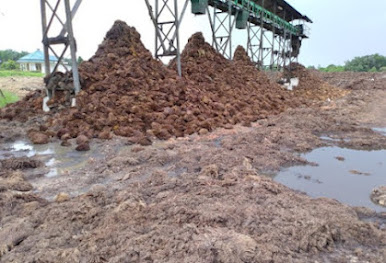
The initial stage that can be done is the cost of the same fertilizer but the productivity of the palm oil fruit can increase up to for example 30%. Furthermore, if this can be achieved, fertilizer consumption will be reduced for example up to 30% but palm oil productivity can be maintained at that level. This is possible when biochar has become a microbial colony and the quality of the soil increases so that uptake of fertilizer is maximal. Biochar is one of the media that can be used for this. An empty fruit bunch that is widely available in palm oil mills and is generally not utilized as a raw material for biochar production. A palm oil mill with a production capacity of 60 tons / hour FFB will produce EFB 13.2 tons / hour so that if the palm oil mill operates 20 hours / day the EFB produced 264 tons / day. The production of biochar with pyrolysis can also produce liquid smoke which can also be used as fertilizer.
Why can biochar be used to increase palm oil productivity and even reduce fertilizer consumption? This is because biochar with its pores with a surface area of ​​about 200 m2 / gram can hold the fertilizer from washing, maintain moisture and many soil microbes that can live in these pores thus improving the physical and chemical properties of the soil. Biochar can last up to hundreds of years in the soil so it does not need to be added every year when the amount is sufficient. Biochar implementation can be started from small scale to massive scale. To process empty fruit bunches (EFB)  in the palm oil mill into biochar, a continuous pyrolysis equiment is needed, to be more clearly read here. To monitor the effectiveness of biochar on oil palm plantations today can use internet technology or IoT (Internet of Things) and for more details can be read here and here.